Designing Trust for India’s Tractor Economy
Transforming an IoT-enabled tractor tracking product into a trusted business platform for fleet owners and farmers across rural India.
My Role
Product Strategy · UX Architecture · Service Design · Research

6x
User Growth
5x
Revenue Increase
+17%
Retention Improvement
9.4
Net promoter Score
Understanding the Rural Tractor Economy
In rural India, tractors are not just vehicles they are income-generating businesses.
Fleet owners rent tractors to farmers for agricultural operations such as ploughing, sowing, and harvesting. Payments are often tracked manually, collections happen across villages, and operational visibility is extremely limited.

How operations ran
Phone calls to confirm Location and details.
Handwritten notebooks for tracking work.
Middlemen collecting payments.
Memory-based accounting.
Resulting
Fuel theft went unnoticed.
Payment disputes were common.
Operations were inefficient.
Owners had no visibility into their own business.
Collections were delayed.
GPS tracking looked like the obvious fix - know where the tractor is, and the rest follows. But location alone doesn't tell an owner who owes them money, whether a job actually got completed, or whether the business is healthy.

The Product Was Monitoring Tractors.
Users Wanted to Manage Businesses.
Research & Field Discovery
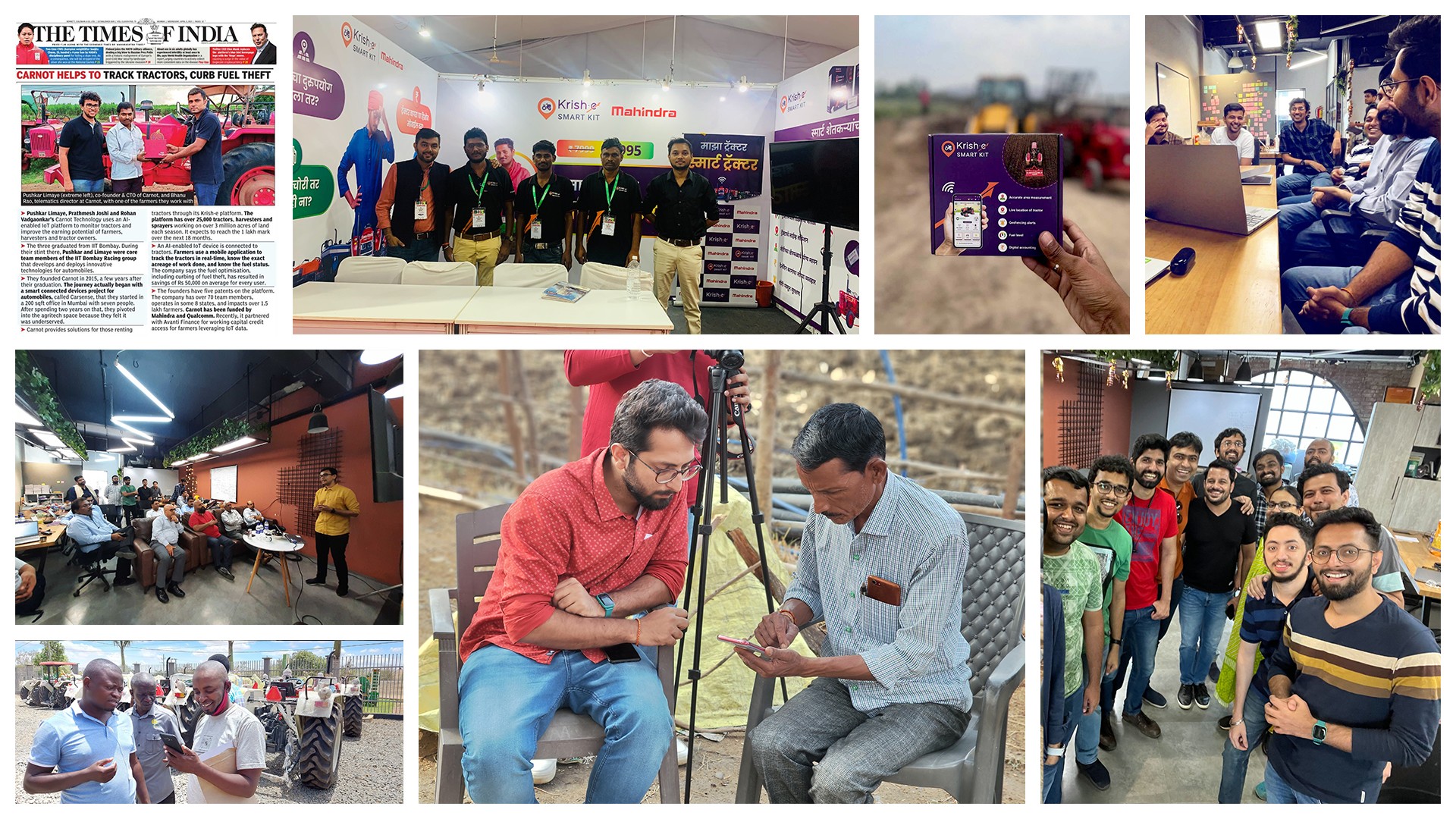
To understand what owners actually needed beyond location tracking, we went into the field talking to farmers, fleet owners, and the teams who worked with them every day.
We wanted to understand
How rural operators make decisions?
How trust is built?
How accounting works in reality?
How users perceive technology?
Research Included
150+ farmer & fleet owner interactions.
in-person village visits.
Workflow Shadowing.
Remote Interviews.
Internal Audit with Sales and Support Team.

Insight 01: Visibility builds trust
Users rarely explored deeply nested interfaces. Instead, they expected:
Important information upfront
Highly visible actions
Operational clarity immediately on entry
Minimal interfaces reduced confidence rather than simplifying usage.

Insight 02: Existing offline systems were already working
Most tractor owners maintained manual accounting notebooks (“khata systems”). The problem wasn’t lack of process. It was:
Fragmentation
Delayed Collections
Lack of Transparency
Operational Inefficiency
This became the foundation for the Digital Khata strategy.

Insight 03: Perceived Value Needed to Feel Tangible
Users associated “premium products” with:
Richer interfaces
Denser information
Visible utility
Daily operational relevance
A sparse screen felt “empty” rather than simple.

Defining The Transformation Strategy
The redesign was not approached as a cosmetic UI refresh. It required repositioning the product from:
Passive monitoring to Operation management app.

Pillar 01: Operational Visibility
Tractor activity
Work completed
Fuel usage
Trip history
Operational performance
Pillar 02: Financial Transparency
Track collections
Manage pending payments
Reduce disputes
Digitize accounting workflows
Pillar 03: Daily Utility
Creating enough recurring value for the product to become part of everyday operational behavior.
Designing for Rural Mental Models
Conventional mobile UX leans on progressive disclosure, hide complexity, reveal it as users explore.
Our research showed the opposite was true for rural operational users. They didn't explore. They acted.
That difference shaped three core principles:

Higher Information Density
More operational metrics surfaced directly on the home screen, rather than tucked behind taps.
Action-Driven Navigation
Critical workflows stayed immediately accessible, not nested inside menus.
Visual Familiarity
Interfaces used language, iconography, and terminology users already recognized from offline life not generic app patterns.
Initiative 01: Digital Khata & Collection Management
Problem
Collections were managed manually across villages passed through middlemen, tracked by memory, and reconciled late.
Design Insight
Owners already trusted notebook-based accounting. Rather than replace that behavior, we digitized it.
Solution
Farmer-wise payment tracking.
Pending collections.
Operational invoicing.
Work-to-payment visibility.
Contextual farm records.
This followed directly from Higher Information Density and Visual Familiarity — payment status surfaced on the home screen, in language and structure owners already recognized from their own khatas.

Initiative 02: Premium Perception & Trust
Once collections were solved, a second problem remained: users struggled to justify paying for GPS tracking alone. Location data, by itself, didn't feel like something worth a recurring fee.
We repositioned the experience around operational intelligence rather than tracking. Surfacing business empowerment and visible value instead of a dot on a map. The interface was built to communicate three things at a glance: capability, utility, and value density.
This drew on Action-Driven Navigation the value of the product had to be visible the moment the app opened, not discovered after several taps.

Closing Statement
Owners didn't need a better tracker they needed a reason to trust the system running their business. Once the product spoke their language, adoption followed: active users grew 6x, revenue 5x, and retention jumped from 53% to 70%, with an NPS of 9.4 from owners who'd once dismissed the app as "just a tracker."
That shift in trust and adoption became part of the platform's growth story one of the factors behind the company's acquisition by Mahindra.
Retrospective
Minimalism is contextual.
Reducing visible information reduced confidence, not complexity for these users, less wasn't simpler, it was less trustworthy.
Trust is a product feature.
Operational users needed transparency and explainability as much as they needed accuracy. A tracker that couldn't explain itself wasn't trusted, regardless of how precise it was.
Designing for emerging markets means designing for existing behavior.
Many conventional UX assumptions failed in low-literacy, operationally complex environments. The features that worked best didn't introduce new behavior they digitized behavior users already trusted offline.
Other Projects

Fleet Monitoring System
We designed a platform that consolidated competitor tracking, market share trends, and sales performance into one workspace, giving teams a clear read on where they were winning, where they were losing ground, and why.
Password Protected


Video Telematics System
Designed an intelligent video telematics experience that leverages in-cabin and on-road smart dashcams to identify unsafe driving events, deliver timely interventions, and help fleets build safer driving habits.